
DMS's Decarbonization Challenge Beginning with the Production Process ― Toward Achieving Zero GHG Scope 2 Emissions across All Factories ―
Introduction
Based on OMRON's corporate philosophy of “Creating a Better Society,” DMS (Device & Module Solutions Company) aims to realize a sustainable society through environmental initiatives such as addressing climate change and transitioning to a circular economy.
In particular, DMS is strengthening its efforts to "decarbonize the production process itself," which is one of the important themes of environmental initiatives. Against the backdrop of tightening global regulations, reducing CO2 emissions during product manufacturing has become an important criterion for corporate activities.
Considering these environmental changes, DMS is accelerating the reduction of GHG emissions in its manufacturing processes by improving production efficiency through energy savings and promoting the shift to 100% renewable energy*1 at all our global factories.
Talk about DMS's Green Strategy: Click here for the interview article
Two Approaches Supporting the Production Process
- Optimization of production efficiency and energy usage
On our production lines, we have visualized power losses in existing equipment and pursued continuous improvement.
We have also achieved improvements in energy efficiency by introducing new equipment with excellent energy-saving performance. As a result, we succeeded in significantly reducing electricity consumption from FY2021 through FY2024. These achievements are not the result of one-off initiatives, but rather the result of accumulated on-site improvements. We will continue to promote sustainable energy savings and productivity improvements while disclosing progress on our efforts as appropriate. - Active adoption of renewable energy
All our domestic bases have already switched all the electricity to renewable energy sources*1. This has resulted in virtually zero CO2 emissions (Scope 2) from electricity at our domestic factories, which has had a direct positive impact on the CFP (Carbon Footprint of Products) of DMS products. This has also allowed us to provide customers with a clear benefit: adopting DMS products enhances the environmental value of their own products.
Learn about DMS's efforts to reduce its carbon footprint
Click here for DMS's product lineup contributing to your decarbonization
Achieving zero Scope 2 emissions*2 by FY2026
DMS is working on a roadmap to achieve zero Scope 2 emissions at its manufacturing sites by FY2026.
This initiative represents a pioneering effort*3 compared to our competitors, and by realizing it earlier than anyone else, we aim to contribute to society and our customers as a cutting-edge environmental company.
| FY2021 | Strengthened energy-saving activities |
|---|---|
| FY2024 | Achieved zero Scope 2 emissions at all our domestic manufacturing sites and Malaysia factory |
| FY2026 | Achieve zero Scope 2 emissions at all our global manufacturing sites |
This also lays the groundwork for future enhancements to CFP requirements.
Transforming to a sustainable production model
DMS is transforming its entire manufacturing process into a sustainable model through energy-saving promotion and renewable energy utilization.
Through this initiative, we provide multifaceted value, including:
 Improved production efficiency through energy savings
- Enhanced environmental value of products
- Support for customers' decarbonized management
Lastly
Achieving 100% renewable energy*1 at our domestic factories is a central measure of DMS's green strategy. Through its track record in energy-saving improvements and the expansion of renewable energy adoption, DMS continues to evolve as a leader in clean manufacturing as an electronic component manufacturer.
From small electronic components to future environmental value
DMS will continue to work with our customers toward achieving a decarbonized society.
*1 : Includes those invalidated through renewable energy certificates such as J-Credits.
*2 : Actual greenhouse gas emissions (Scope 1 and 2) for FY2023 are posted on the OMRON Corporate website and have been assured by a third-party organization through limited assurance engagement. This limited assurance engagement complies with the International Standards on Assurance Engagements (ISAE) 3000, “Assurance Engagements Other Than Audits or Reviews of Historical Financial Information,” issued by the International Auditing and Assurance Standards Board.
*3 : This compares the target years for achieving zero Scope 2 emissions based on publicly available information (such as sustainability reports up to December 2025) from major electronic component manufacturers and five of our competitors according to OMRON's research.
 Editorial supervisor:
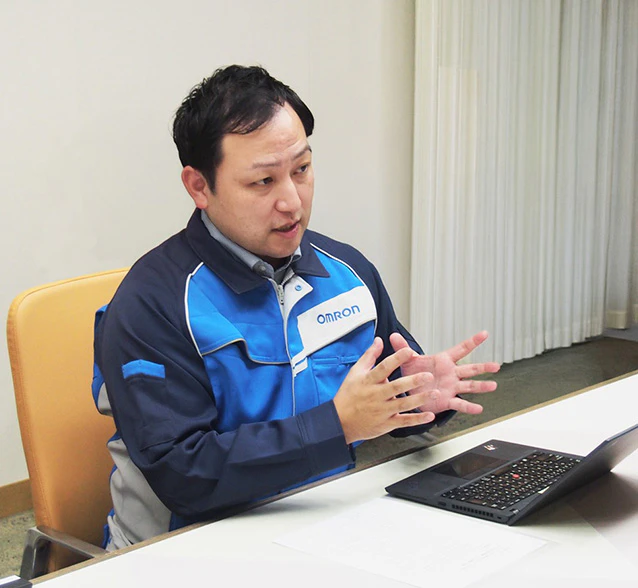
Kazuyuki Okada
DMS GREEN PROJECT Leader
Business Planning Department, DMS Strategy Planning Division
(Device & Module Solutions Business)
As the leader of the GREEN PROJECT, which drives environmental value creation in the electronic components business, I am responsible for promoting the decarbonization of production processes and CFP (Carbon Footprint of Products) calculations.
In collaboration with the Sustainability Department at our headquarters, I have consistently led the process from formulating internal rules and guidelines regarding LCA/CFP to rolling them out and establishing them at our manufacturing sites.
I built a CFP calculation system in our electronic components business from scratch and standardized the calculation rules.
As of the end of February 2026, we have completed CFP calculations for over 30 models, and I have supervised the content of this article regarding decarbonization of production processes and Scope 2 reduction based on these practical experiences and knowledge.